
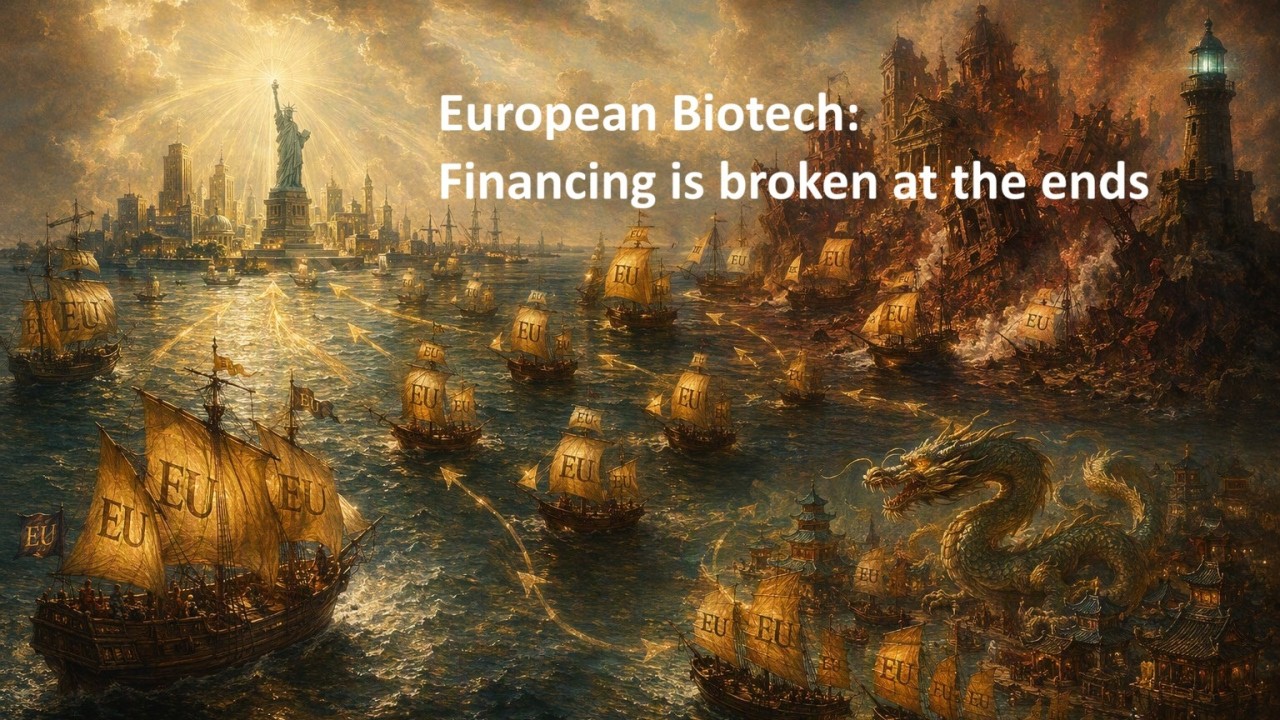
Europe’s biotech ecosystem is broken at the ends
The middle holds. The ends are collapsing.
Fresh startups and near-commercial firms are strained and cannot access capital in EU. Without more qualified early-stage funding now, there will be no mature EU biotech to invest in within a few years.
A tier of well-capitalised European biotech funds now exists that didn’t a decade ago. Forbion manages €5B across 11 funds. Sofinnova manages over €4B across seven strategies and raised €1.2B over the past year. EQT Life Sciences manages around €3.5B across 12 funds. Jeito Capital closed its second fund at €1bn in 2026, tripling its AUM to €1.6bn. These are credible, scaled managers capable of leading €80–150M growth rounds and delivering globally competitive exits. That progress is real. And it is highly appreciated.
But a dozen or so funds does not make a deep mid-market for drug development. Later-stage European companies with robust data can attract global syndicates — early-stage ventures remain in a funding drought. Building more large funds — heavily co-invested with EU and national sovereign vehicles — doesn’t fix either end. It should even be expected that these funds will at some point take portfolio companies to the US, because the European public markets are not competitive at scale. The ends are broken, and they are broken in different ways.
The early end: a draining tank no one is refilling
The early-end problem is easy to miss, because on the surface 2025 looked fine. European early-stage deployment held up: in Q3 2025, early-stage rounds were roughly 60% of all European venture funding, buoyed by deep tech, biotech and AI [Crunchbase, Oct 2025]. Stifel data shows European biopharma venture volume broadly matched 2024, with early-stage rounds the largest share of both deal value and volume [Ropes & Gray, March 2026]. Read quickly, that looks like health.
It isn’t. What those figures capture is deployment — funds spending down dry powder they already hold. What they hide is replenishment, and that is where the failure sits. European VC fundraising in 2025 was, in the Centre for Economic Policy Research’s phrasing, a particularly woeful year, even as investment volume recovered [CEPR, 2026]. Globally, VC dry powder has fallen 19% from its 2023 peak of $743.9B to $600.9B, after three consecutive years of declining fund closes [S&P Global, Dec 2025]. The tank is still being emptied at a normal rate. Almost nothing is filling it back up.
And the little that does refill it is being funnelled to the wrong place for early-stage science. LPs have grown more selective, concentrating commitments in established managers offering several strategies, while smaller and first-time funds that thrived in a more buoyant climate now struggle to attract commitments [Labiotech, Oct 2025]. As one private-markets partner put it, a newer manager trying to raise even a $500M fund faces tough sledding [S&P Global, Dec 2025]. The specialist vehicles that do the earliest work are responding by consolidating to survive: the Asabys–Aliath integration in 2025 — small life-science teams combining under one roof to reach scale — is the visible shape of that pressure [Labiotech, Oct 2025]. Fewer, bigger funds is not a neutral reshaping. It moves capital and attention structurally away from the messy and difficult first cheque.
This shows up at the earliest stage first, because that is where the small, patient, specialist funds operate — and in Europe it already has. Pre-seed and seed recorded the steepest year-on-year drop of any stage in European dealmaking in H1 2025, as investors sought safety in larger, more mature rounds [PitchBook, July 2025]. The global biopharma picture frames the same squeeze: seed and Series A round counts fell from 228 in 2024 to 191 in 2025, with capital at those stages slipping from roughly $10.6B to $8.7B [J.P. Morgan Q4 2025 Biopharma Licensing & Venture Report]. Of all venture deals completed in 2025, 65% went to later-stage companies and just 35% to earlier-stage ones. J.P. Morgan put it plainly: VCs are prioritising biotechs with “established data packages, de-risked development and nearer-term catalysts” [J.P. Morgan, Q1 2026].
What gets lost in those statistics is the nature of what early-stage biotech actually needs. The first 1–3 years — the period between interesting science and a fundable asset — requires small, patient, scientifically-literate capital. Capital to help a founding team design the right proof-of-concept study, navigate the IND pathway, and arrive at a Series A with a story that institutional investors can price. That capital is disappearing, not because the science is worse, but because the incentive structure now points elsewhere.
The consequence is that the feeding channel is starved, with impact on both quantity and quality for later-stage investors. This will unquestionably impact the ability of the funds in the middle to realise strategies based on European science and research.
This is not an argument for funding every science project. Selectivity is the core skill here — as it has always been. The ask is not more capital deployed indiscriminately. It is more funds with the scientific judgement to know which five out of fifty deserve the bridge, and the operational capability to help them cross it. Being early is not necessarily just about funding or not; it should be about aiding the companies in shaping their narrative, thinking about the TPP earlier than they expected, and designing experiments with the potential to kill the project if it cannot deliver.
The assumption that grants and national innovation programs will fill what’s missing is misplaced. No grant program sits on your scientific advisory board, interrogates your CMC strategy or helps you design the experiment that gets you to Series A.
The fundability bridge — years 0 to 3 — is being quietly abandoned. The assumption is that somebody else will handle it. Only a few really are. And if the people who help the inventors, professors and post-docs — and the funds that keep that early-stage support alive — continue trending toward zero, so will the pipeline of European biotech projects with any chance of becoming fundable entities.
And there is now a cheaper substitute for the bridge entirely. While Europe lets its fundability bridge erode, China has built a parallel one: cross-border out-licensing by Greater China biotechs reached a record $137.7B in 2025, with nearly three-quarters of those deals for assets at preclinical or Phase 1 stage [PharmCube, Feb 2026; PitchBook, Jan 2026]. European life-sciences funds are already beginning to source and in-license China-developed assets rather than build them at home — and every euro routed to a ready-made Chinese asset is a euro not spent carrying European science across years 0 to 3.
The late end: a sovereignty problem dressed as a financing problem
European life sciences VC accounts for just 7% of the global market, compared with 63% in the US and 14% in China [Invest Europe / European Commission].
Of the 67 EU biotech companies that went public over the past six years, 66 chose to list outside Europe [European Commission, Biotech Act]. Read that again. 66 out of 67. Outside Europe.
Between 2015 and mid-2025, EU biotech startups attracted €25B in venture capital. In the US, that figure was €219B — a roughly 9x gap [European Commission, Biotech Act communication, Dec 2025]. Europe hosts world-class science, yet captures a fraction of the capital, and almost none of the public market value creation. And what is the point of all of that, if the companies end up filing S-1s and F-1s on Nasdaq in New York the moment real money is needed — for Phase 3 and commercialisation?
The Nasdaq migration is not irrational. The “European discount” is documented and persistent. Nasdaq itself reports that 100% of eligible biotech companies listed on Nasdaq in full-year 2024 [Nasdaq IR, Dec 2024]. US specialist funds — OrbiMed, Perceptive, RA Capital — dominate biotech financing globally but primarily invest in European companies at the private stage rather than in European public equities. By the time a company needs real public market capital, the logic for Nasdaq is overwhelming.
The dominant pattern is now well-established: list on Euronext early for lower costs and faster timelines, then migrate to Nasdaq once you need scale, as Argenx and Galapagos did. But that model institutionalises the drain — and some now skip Europe altogether. As recently as early 2026, Belgian biotech Agomab chose to list directly on Nasdaq, bypassing European exchanges entirely [European Biotechnology Magazine, April 2026].
The IPO data makes the point starkly. In 2025, only nine biopharma companies went public in the US, raising just $1.6B — the lowest IPO capital raise in five years, against $3.8B from 19 biopharma IPOs in 2024 [Ropes & Gray, March 2026]. In Europe, the market was nearly silent. The post-Phase 3 commercialisation gap is real: capital to build a sales force, navigate reimbursement and launch across 27 fragmented markets does not exist at European public market level.
This is not just a financing problem. It is a sovereignty problem. The pattern of European mid-cap pharmas acquiring US biotechs — Chiesi’s $1.9B takeover of KalVista is one of several recent examples — reflects a “structural vice” where European companies must spend to access US growth dynamics that they cannot find at home [BioSpace, May 2026]. Every European biotech listing on Nasdaq or selling to a US major is a decision about drug pricing, access, manufacturing location and R&D direction that moves permanently out of European hands.
The EU Biotech Act, proposed December 2025, correctly identifies late-stage capital as the critical failure. Its headline ambition is to mobilise roughly €40B annually over the next decade through EU public money, national schemes and public investors [Euronews, Dec 2025] — though the concrete instrument, the Health Biotech Investment Pilot run with the EIB Group, is far smaller in its initial phase: up to €10B across 2026–2027 [EIB, Dec 2025]. The ambition is significant. But the core instrument is another private vehicle. It does not create liquidity. It does not build analyst coverage. It does not keep a company European once it enters the public markets.
What Europe needs is a life sciences-focused, or at least a life sciences competent, stock market that offers what Nasdaq offers in the US. And unless the structure of Europe’s many small, diluted public markets changes, the answer has to be consolidation — ONE well-functioning marketplace with a sector focus. Spreading the few listings we generate across ten small exchanges only compounds the problem.
So, what would actually fix this?
On the early end: more dedicated biotech vehicles, and the LP capital to sustain them. That means commitments to the small-specialist model rather than a reflexive flight to the largest established managers — and LPs willing to accept the carry timeline that genuine early-stage conviction demands. The UK’s Mansion House principle of directing pension capital toward a defined private-asset class points the right way, though early results are modest. And it means the discipline to back the few that deserve the bridge, not to spray capital at anything with a sequencer.
On the late end: a European public market actually built for biotech — pre-commercial, high-risk, highly regulated. Dedicated indices, specialist crossover funds with EU mandates, real analyst infrastructure, and institutional investors — pension capital included — willing to hold post-Phase 3 commercial risk on European soil. The continent needs its own equivalent infrastructure, and the conviction to consolidate.
This is Draghi’s September 2024 report playing out in full, in real time [Draghi report, Sept 2024]. He warned almost two years ago that Europe invents and others commercialise. Biotech is the clearest case of it. Starved at the start. Drained at the finish. European pharmaceutical companies, although leaders in drug discovery and development, face structural challenges in translating innovation into commercial success.
The middle doesn’t need more attention. The edges do.