
In late 2025, Sunstone set out to understand a simple question: how has the Novo Nordisk Foundation‘s ~€500M investment into BioInnovation Institute (BII) Institute (2018) influenced the creation of new biotech companies in Denmark? The answer surprised us.
After steady growth from 2010 to 2018, the number of new Danish companies developing novel therapies has declined, reaching its lowest level in 2025. At the same time, the number of seed-stage companies has continued to accumulate since 2019—creating an increasingly competitive bottleneck at the Series A stage. We posted the analysis here: https://lnkd.in/eR4KYEU3
The analysis raised a bigger question for us: is the decline in new companies just a local phenomenon, or part of a broader shift?
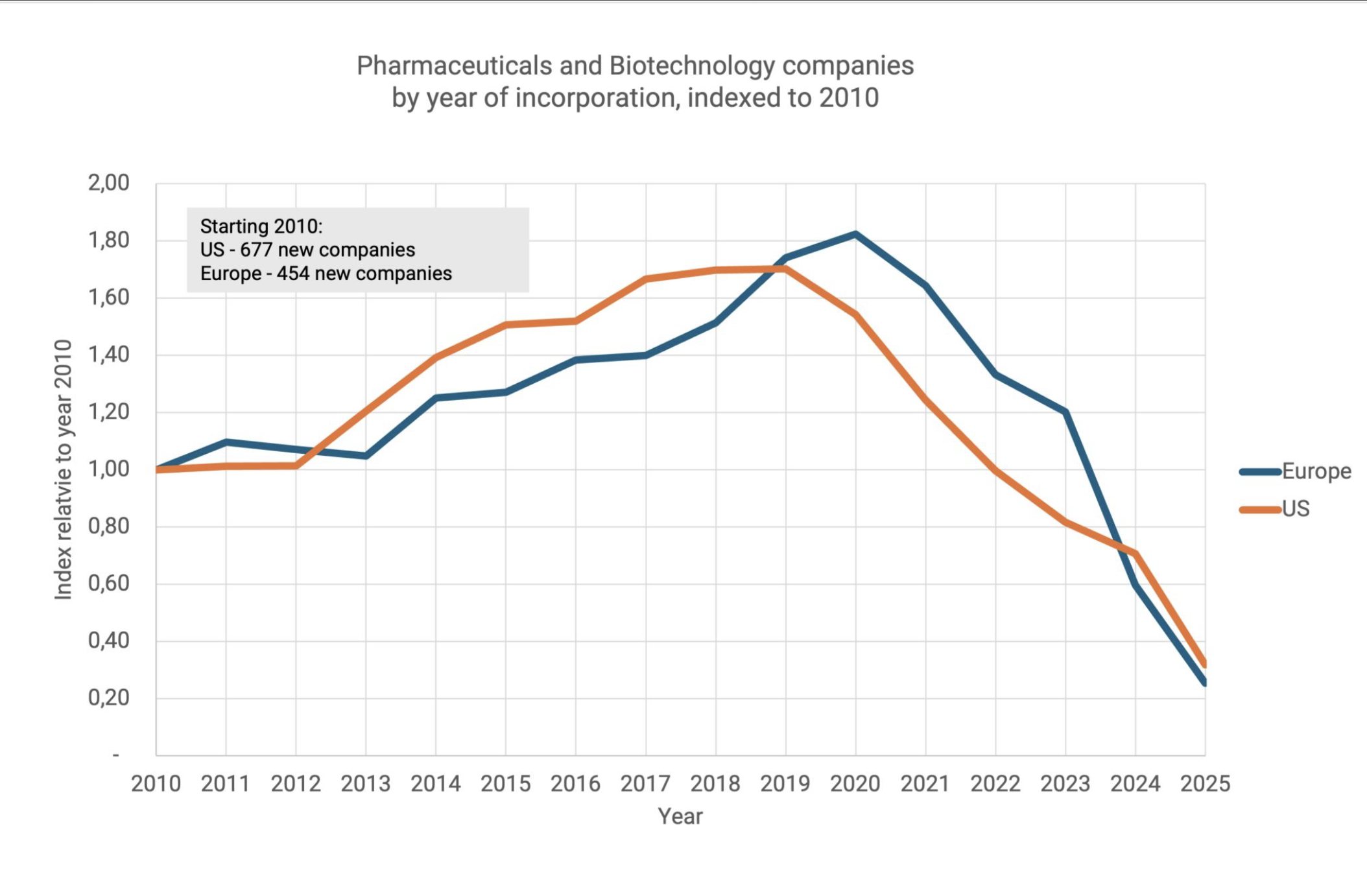
To answer that question, we analyzed global data from PitchBook, indexing biotech and pharmaceutical company formation to 2010 levels. The pattern is striking. In Europe, company creation appears to peak around 2019; in the US, around 2018. Since then, the pace has slowed on both sides of the Atlantic.
So what is going on?
Is academic innovation losing momentum? Are entrepreneurs reacting to a perceived tightening of capital, or reacting to geopolitical uncertainty? Has biotech, at least temporarily, fallen out of favor? Or did COVID create a structural disruption that we are still working through?
What makes this even more puzzling is that other signals do not point to a lack of underlying innovation. Scientific publications and patents remain stable or are increasing. Venture capital availability doesn’t seem to have dried up either—biotech fund formation actually peaked around 2020. And while biotech is slowing, other technology verticals such as AI continue to accelerate.
Which brings us to the question that matters most for investors.
Are we entering a period where fewer new companies could lead to stronger returns? Will scarcity drive higher valuations and earlier investment strategies? Or is this the early sign of a more fundamental slowdown in biotech innovation in EU and in US?
We have debated this extensively internally and, so far, we don’t see a single clear answer.
So looking at the graph, we would genuinely value your perspective:
Is this a concern—or an opportunity?
Notably, Denmark has actually held up better than Europe as a whole since 2019 — which may reflect the long-term impact of the Novo Nordisk Foundation’s ~€500M investment into innovation after all.