
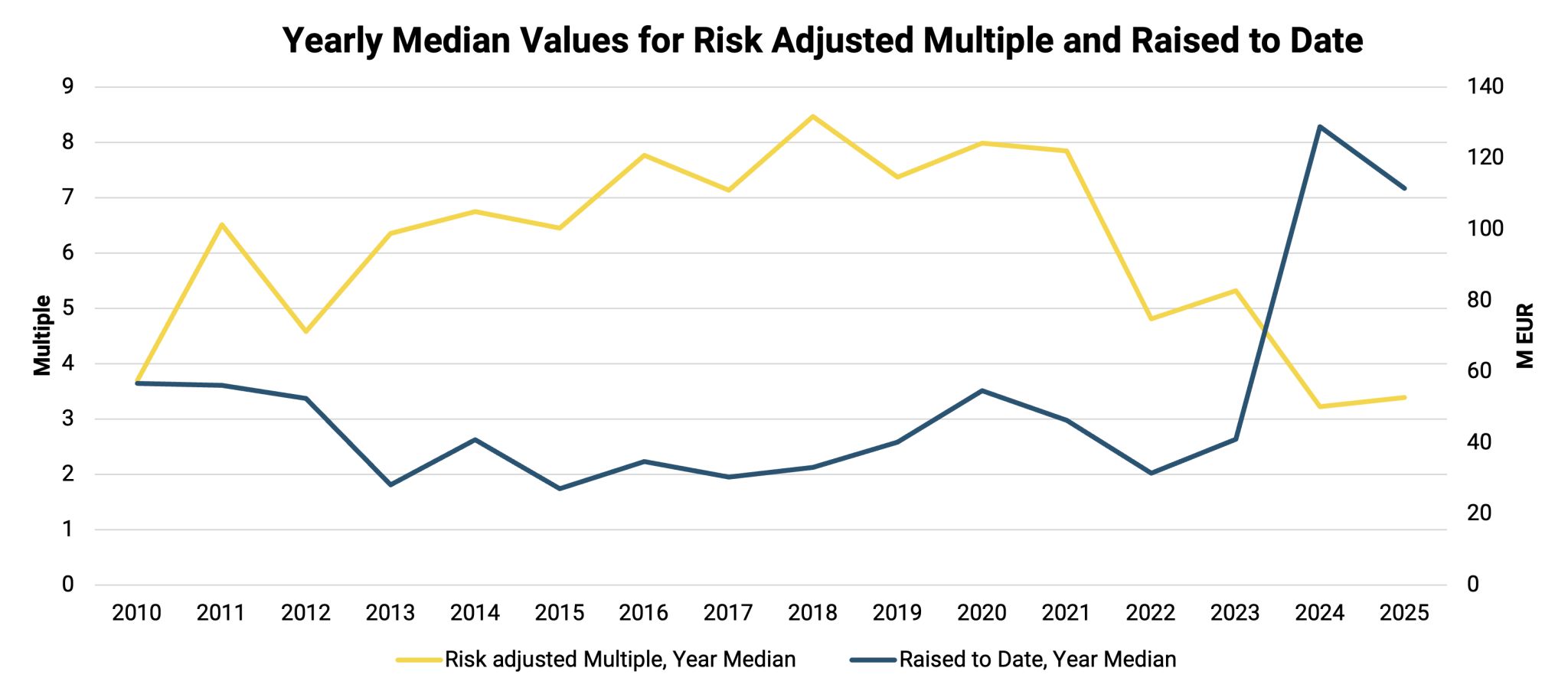
At Sunstone we continue to track risk-adjusted return multiples (adjusted for contingent payments) versus the total capital invested in private therapeutic companies prior to M&A exits. When looking at the median trends over the past 15 years, the inflection starting around 2022 is striking. Capital invested per company before exit has increased markedly, while at the same time the risk-adjusted return multiples have moved in the opposite direction.
What makes this particularly noteworthy is what has not changed. The number of M&A transactions per year has remained broadly stable, and the clinical stage at which companies are acquired has not shifted materially. Pharma is not systematically buying later or more expensive assets. Altogether, this suggests that the overall annual risk-adjusted M&A value pool has stayed roughly constant. In simple terms, companies that exited through M&A in the past three years appear to have required more capital without receiving higher acquisition prices.
This creates a real challenge for the venture model. With risk-adjusted multiples now approaching three, the math becomes uncomfortable. A venture fund typically targets around a 3x return across the portfolio, yet current exit multiples effectively assume near-zero failure rates to make the model work. That is clearly unrealistic. Either we need to invest less per company or exits need to command higher prices. At the moment, neither trend is visible.
The timing overlaps almost perfectly with the biotech IPO drought of the past two years. Investors have likely been extending company runways while waiting for public markets to reopen, while potential acquirers have been able to cherry-pick from both listed and private companies without needing to match increased invested capital with higher acquisition prices. Investments have gone up, but multiples have come down.
The magnitude of this shift also highlights something more structural. Exit through M&A is largely constrained by the acquisition capacity of the pharmaceutical industry. If value realization depends primarily on M&A, then more innovation does not automatically translate into more value creation; we are all competing for the same pot of gold.
This brings attention to what may be the real bottleneck: a public equity market for biotech that is not functioning as it once did, particularly in Europe. Policymakers often focus on stimulating innovation, which is attractive and relatively inexpensive, but the incentives for investing in listed biotech remain weak and politically sensitive. Yet a healthy public equity market is one of the strongest drivers of biotech innovation, value creation, and ultimately societal benefit.
Is the recent drop in multiples simply a cyclical fluctuation, or does it point to a deeper structural issue in the public biotech market?
Feel free to share your thoughts?