Biotech innovation is slowing down! — are we entering a new opportunity window?

In late 2025, Sunstone set out to understand a simple question: how has the Novo Nordisk Foundation‘s ~€500M investment into BioInnovation Institute (BII) Institute (2018) influenced the creation of new biotech companies in Denmark? The answer surprised us.

After steady growth from 2010 to 2018, the number of new Danish companies developing novel therapies has declined, reaching its lowest level in 2025. At the same time, the number of seed-stage companies has continued to accumulate since 2019—creating an increasingly competitive bottleneck at the Series A stage. We posted the analysis here: https://lnkd.in/eR4KYEU3

The analysis raised a bigger question for us: is the decline in new companies just a local phenomenon, or part of a broader shift?

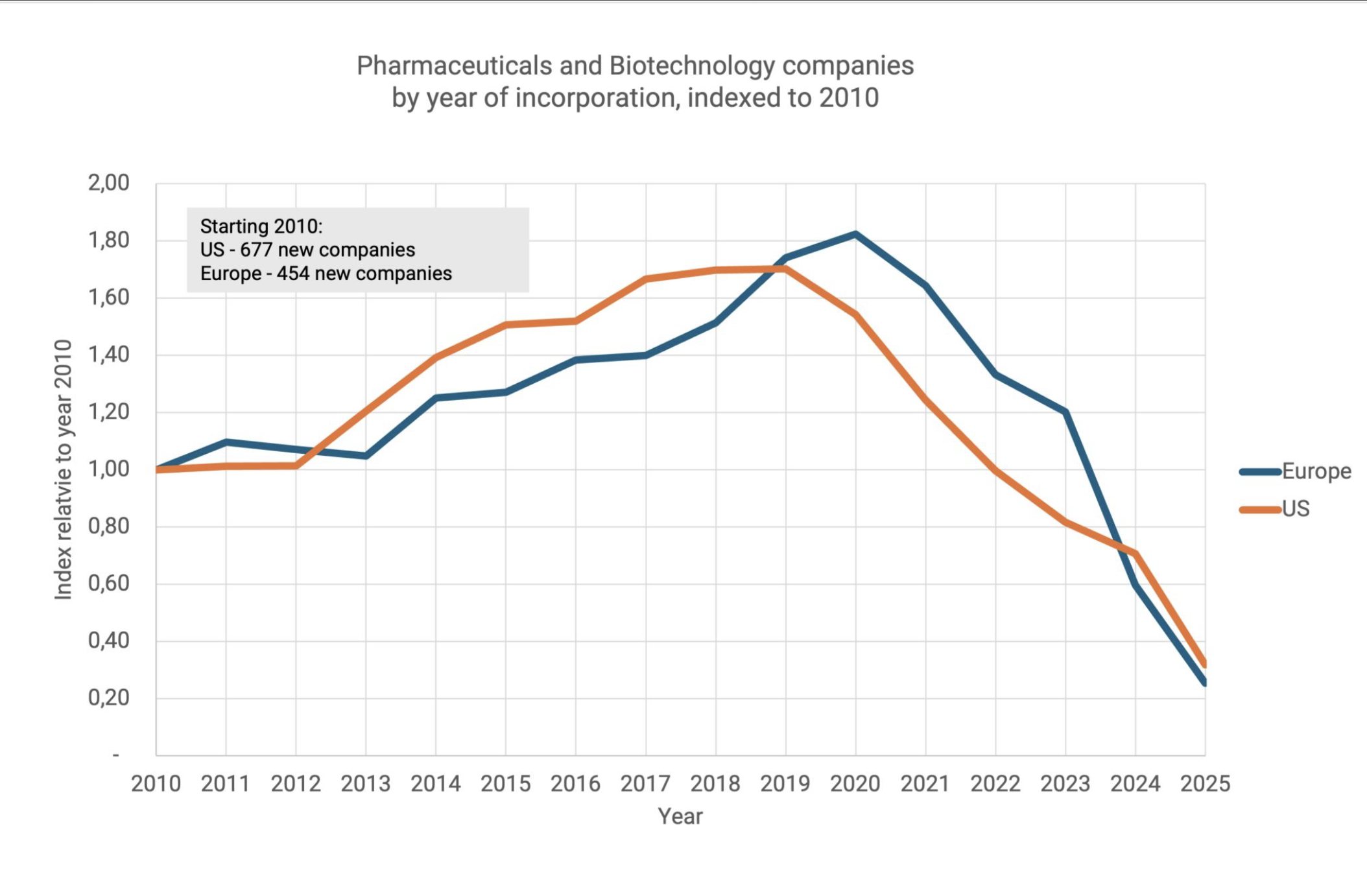
To answer that question, we analyzed global data from PitchBook, indexing biotech and pharmaceutical company formation to 2010 levels. The pattern is striking. In Europe, company creation appears to peak around 2019; in the US, around 2018. Since then, the pace has slowed on both sides of the Atlantic.

So what is going on?
Is academic innovation losing momentum? Are entrepreneurs reacting to a perceived tightening of capital, or reacting to geopolitical uncertainty? Has biotech, at least temporarily, fallen out of favor? Or did COVID create a structural disruption that we are still working through?

What makes this even more puzzling is that other signals do not point to a lack of underlying innovation. Scientific publications and patents remain stable or are increasing. Venture capital availability doesn’t seem to have dried up either—biotech fund formation actually peaked around 2020. And while biotech is slowing, other technology verticals such as AI continue to accelerate.

Which brings us to the question that matters most for investors.

Are we entering a period where fewer new companies could lead to stronger returns? Will scarcity drive higher valuations and earlier investment strategies? Or is this the early sign of a more fundamental slowdown in biotech innovation in EU and in US?

We have debated this extensively internally and, so far, we don’t see a single clear answer.

So looking at the graph, we would genuinely value your perspective:

Is this a concern—or an opportunity?

Notably, Denmark has actually held up better than Europe as a whole since 2019 — which may reflect the long-term impact of the Novo Nordisk Foundation’s ~€500M investment into innovation after all.

What do you think?
Let us know in our feed on LinkedIn:

5 latest press releases

MinvervaX CFO & CDO Appointment

MinervaX ApS, a privately held Danish biotechnology company developing a novel, prophylactic vaccine against Group B Streptococcus (GBS), today announces the appointments of Jamila Louahed as Chief Development Officer and Hans Henrik Chrois Christensen as Chief...

Treetop Meeting

We usually do not share updates from internal meetings - but this was too fantastic not to share. A full day meeting in the midst of branches of +100 year old oaks and beech trees overlooking Isefjorden in “the treetop huts” at Ryegaard & Trudsholm Godser. Spiced...

Hans T. Scambye joins Sunstone as Venture Partner

Sunstone is delighted to announce that experienced biotech executive and CEO of Galecto Hans T. Schambye will be joining our team as new Venture Partner as of 1st February 2025. With a background as an MD and PhD Hans brings to Sunstone over 25 years of experience...

Neumirna Therapeutics secures euro 20M in Series A financing

Neumirna Therapeutics (‘Neumirna’), an RNA-focused biotech company developing next-generation therapeutics for neurological disorders, is pleased to announce the first closing of its Series A funding round at €20M. The investment was co-led by new investors, Angelini...

Ascelia Pharma Successfully Meets Primary Endpoint with Strong Headline Results in Orviglance Phase 3 Study

Ascelia Pharma AB (publ) (ticker: ACE), a biotech focused on improving the life of people living with rare cancer conditions, today announced that liver imaging drug candidate, Orviglance®, significantly improved visualization of focal liver lesions, successfully...

5 latest articles

Is biotech venture capital investing more to return less?

At Sunstone we continue to track risk-adjusted return multiples (adjusted for contingent payments) versus the total capital invested in private therapeutic companies prior to M&A exits. When looking at the median trends over the past 15 years, the inflection...

An update on M&A returns for biotech venture capital

Back in in 2019 Sunstone started sharing studies of European venture capital funded successes – i.e. M&A transactions. In 2021 we started adding US M&A’s to the data and later the same year we evaluated to which extent an IPO impacted the observations made....

Biotech ecosystem contributors!

Biotech ecosystem contributors! In our previous post, we discussed the importance of local investors and how, in a Danish context, they contribute to identifying and scaling local and regional therapeutic innovation. However, not all investors are born equal - and an...

Do local investors make a difference?

Do local investors make a difference? E-mail outreach, online meetings and digital data rooms have become a given when trying to finance a therapeutic innovation! So, do local or regional anchor investors matter when developing a bioinnovation ecosystem? If the local...

Seed & Series A in Denmark

Financing a Danish Biotech company has apparently never been more challenging. Based on feedback from partnering meetings in 2025 it seems that raising Series A financing has become an unprecedented challenge. However, when looking at the available data on the...

The 10 Advisements

We have the utmost respect for the courage, dedication, and resilience it takes to be an entrepreneur in our industry - especially when you’re out raising your next round of financing. That’s why we’ve decided to share our “10 Advisements” for crafting a compelling...